
How to pass on a deal without losing the person who sent it

Your phone buzzes. An address, three photos, a price, and four words: "You want this one?"
You look at it for ten minutes and you already know. The numbers don't work for you, the area isn't one you buy in, or the rehab is bigger than the spread. It's a no.
Here's what most people get wrong about that moment. The person who sent it matters more than the deal. And how you say no decides whether their name ever shows up on your phone again.
So here's the short version: pass quickly, give one honest reason, leave them something useful, and tell them what you would say yes to. If you're already under contract and your contract gives you an option period, pass inside that window, and don't wait for the last day.
That's the whole article in a paragraph. The rest is how to do each piece without it feeling awkward, and why it matters more than it looks.
Most of the deals you see, you'll pass on
Anyone who is actively looking at property says no far more often than yes. Usually that means you have a process.
But look at who's on the other end of all those no's. A wholesaler who works the same neighborhoods every week. An agent who hears about listings before they hit the market. A friend from your investor group who got a lead they can't use. A seller's cousin who heard you buy houses.
Those people aren't one-time transactions. They're a pipeline, and every deal they send is a small test of whether you're worth sending the next one to.
We sit on both ends of this. People bring opportunities to us, and we bring opportunities to private money partners who are completely free to turn us down. So we know what a good no feels like from the receiving side, and we know what it feels like to send something over and hear nothing back.

Here's a made-up example, but you'll probably recognize it. A wholesaler sends the same three-bedroom to five buyers on a Monday morning.
Buyer one replies within the hour: "Not for me. The foundation work scares me off, but I'd look hard at anything nearby that doesn't need structural repairs." Buyer two says "let me run the numbers" and disappears. Buyers three and four never open the message. Buyer five sends back a number so low it's clearly a no wearing a disguise.
Two weeks later, that wholesaler lands something good in the same part of town. Who gets the first call?
Usually it's the person who is easiest to work with, and a clean, quick no is one of the clearest signals of that.
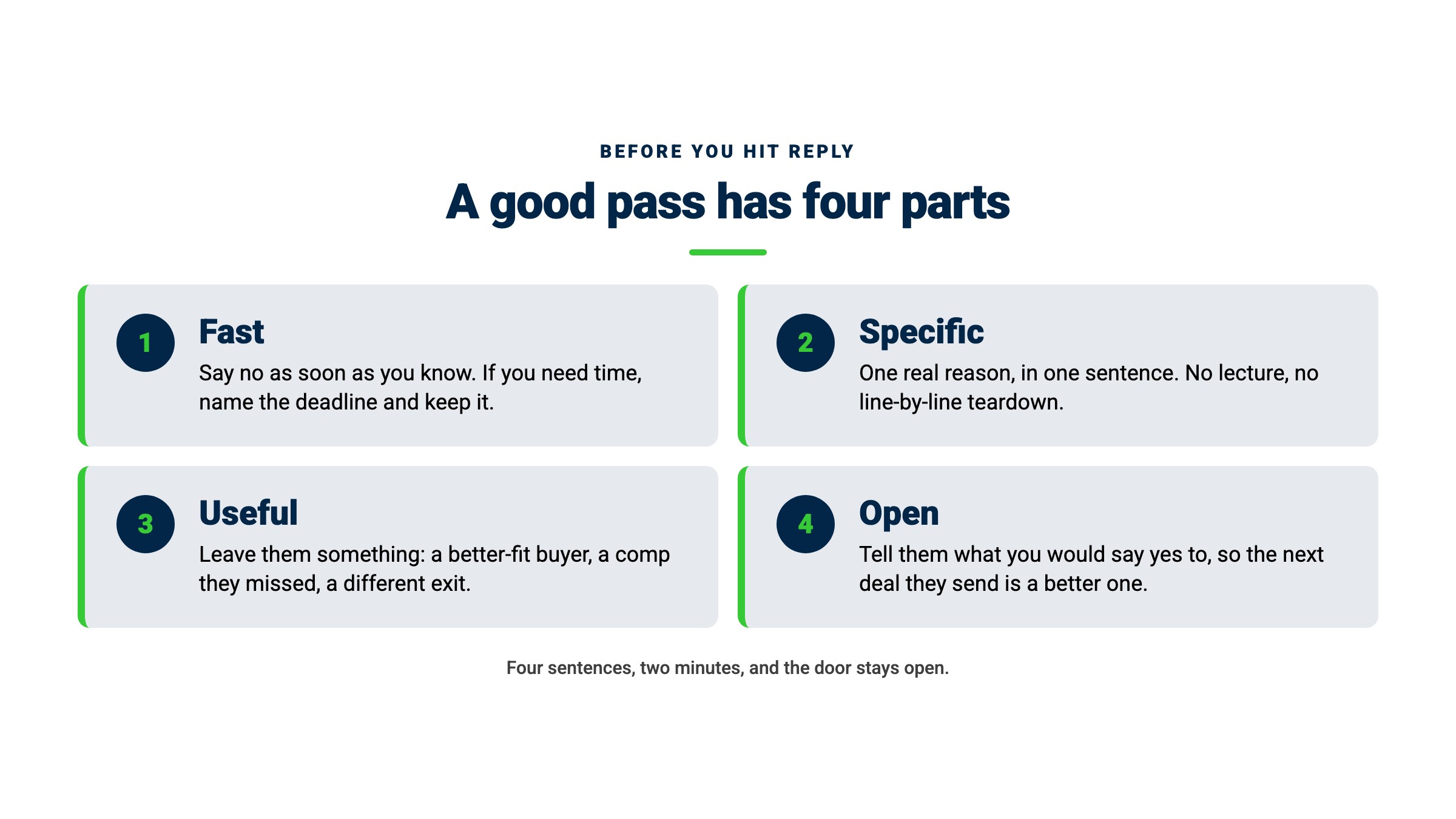
A good pass has four parts
None of this needs a script. But a pass that protects the relationship almost always has these four things in it.
1. Fast. Say no as soon as you know. The person who sent the deal is trying to move it, and every hour you sit on it is an hour they can't count on anyone. A quick no is a courtesy. A slow maybe is a cost you're quietly charging them.
If you genuinely need time, say how much: "Give me until tomorrow at noon." Then answer by noon, even if the answer is no.
2. Specific. Give one real reason, in one sentence. "The rehab is more than we want to take on right now." "It's outside the areas we buy in." "At that price, there's no room left for our exit." You're helping them understand what you buy, and one sentence does that better than a spreadsheet.
A specific reason also saves you from the most common follow-up, which is the same deal coming back at a slightly lower price with the same problem still attached. (We walked through our own reasons to pass on the lending side in what we'd want to know before lending on somebody else's deal.)
3. Useful. Leave them better off than a flat no would. Maybe you know a buyer who loves heavy rehabs. Maybe you noticed a sale down the street they missed. Maybe the property makes more sense as a long-term rental than a flip. Even "I think this is priced for a landlord, not a flipper" points them toward the right buyer.
One boundary: only offer an introduction you'd be comfortable putting your own name on. Handing a deal you think is bad to a friend just passes the problem along.
4. Open. Tell them what you would say yes to. Your price range, your areas, the kind of project you like, how fast you can move. This is the piece almost everyone skips, and it's the piece that turns today's no into a better deal next month.
Put together, it can be four sentences:
"Thanks for thinking of us on this one. We're going to pass, because the foundation work is more than we want to take on right now. You might try the heavy-rehab buyers on your list. If you find anything nearby that's cosmetic only, we'd love a first look, and we'll get you an answer the same day."
That message takes two minutes to write. It tells the sender you respect their time, why this one missed, where to take it, and exactly what to bring you next.
Three ways a pass quietly ends a relationship
Most relationships in this business don't end in an argument. They just stop. And a lot of the time, it's one of these.
Going silent. Ghosting can feel gentler than saying no. But the other person doesn't know whether you're still looking, whether an offer is coming, or whether they should call somebody else. All silence does is use up their time.
The disguised no. There's a real difference between an honest offer at the price that works for you and a number you send only because you'd rather not say no. If your offer is sincere and you can explain it, send it. If you're sending a number you know they'll reject so that they have to be the one to end it, you've turned a simple pass into a small insult. The same goes for "keep me posted" when you'd never buy it at any price. Don't leave a door open that isn't really there.
The lecture. Sometimes a deal really is overpriced, and it's tempting to show your work, line by line, in the group chat. Don't. If the person asks why, tell them privately, briefly, and kindly. They may have priced it off what the seller needs rather than what the market will pay, and they probably already know it's tight.
Already under contract in Texas? The clock is part of the courtesy
Sometimes the no shows up after you've signed. You got the house under contract, walked it with your inspector, and found out it isn't the project you thought it was.
If the deal is on the standard Texas resale form, TREC's One to Four Family Residential Contract (Resale), form 20-18, the contract itself tells you how much room you have. Paragraph 5 gives a buyer who delivers the option fee on time the unrestricted right to terminate by giving written notice to the seller within the number of days written into the contract, called the option period.
A few details in that paragraph are worth knowing cold:
- The earnest money and the option fee go to the escrow agent within 3 days after the effective date (extended to the next day that isn't a weekend or legal holiday, if the last day lands on one).
- If no option fee amount is filled in, or the fee isn't delivered on time, the buyer doesn't get that unrestricted right to terminate.
- Notice has to be given by 5:00 p.m., local time where the property is located, on the deadline date.
- If the buyer terminates in time, the option fee is not refunded and goes to the seller, and any earnest money is refunded to the buyer.
Once the option period is over, backing out is a different conversation. Under the form's default paragraph, the seller may be able to keep your earnest money or try to enforce the contract, unless another part of the contract or an addendum gives you a way out. Not every Texas deal uses this form, either. Investor purchase agreements and assignment contracts are often written differently, so read your actual contract with your agent or attorney instead of assuming.
Here's where the relationship comes back in. The option period is a deadline, not a target. If you know on day two that you're out, say so on day two. The seller has other buyers to call and the agent has a listing to put back on the market. Waiting until 4:55 p.m. on the last day doesn't give you any more rights than you had that morning. It just costs everyone else the days in between. And the form says time is of the essence, so cutting it that close risks missing the deadline entirely.
What passing well actually gets you
This is the part that never shows up on a spreadsheet.
The way we see it, people who pass well tend to get sent better deals over time, and luck has little to do with it. Every clean no teaches the person on the other end what you actually buy. After a few rounds, they stop sending you everything and start sending you the right things, and sometimes they send them to you first.
It also protects your reputation in rooms you're not in. Investor communities are smaller than they look, especially once you get past the online groups and into the local meetups. The wholesaler you ghosted and the agent you lectured know the same people you'd like to meet. (If meeting those people is on your list, here's how to leave a real estate meetup with something real.)
And it keeps you honest with yourself. Writing one sentence about why you're passing forces you to know why. If you can't name the reason, the deal might deserve a second look.
So here's what we'd offer you: a way to say no that costs you two minutes and keeps the next opportunity coming. Try the four parts on the next deal you turn down this week. Fast, specific, useful, open.

And if more deals are landing on your phone than you'll ever buy, you're probably meeting people worth keeping, too. That's a big part of why we host our meetups. Come say hello, tell us what you buy and what you pass on, and you might just leave knowing a few more people worth keeping.
Disclaimer: This content is provided for educational, informational, and entertainment purposes only. It is not legal, tax, accounting, investment, financial, or professional advice. Michelle and Vin are not acting as your attorney, CPA, financial advisor, or other licensed professional. Every situation is different. Conduct your own due diligence and consult your qualified professional team before making any business, real-estate, lending, investment, legal, tax, or financial decision. Nothing in this article is a promise or guarantee of results.