
You might already be somebody's business partner

Picture two people putting money into a house together. Nobody files anything with the state, nobody signs anything, and both of them call it "going in on a deal."
Here is the part almost nobody hears until it matters: in Texas, those two people may have formed a general partnership the moment they started behaving like owners. No filing, no lawyer, no signature. It can happen on a handshake in a parking lot.
So here is the whole article in one sentence.
In Texas you don't get to choose whether you have a partnership agreement. You only get to choose whether you wrote it, or the state wrote it for you.
And the one the state wrote has terms in it that would surprise most people who are about to shake hands this week.
One disclosure up front, because it bears on a distinction below: we lend. That's part of why we watch the line between lender and partner so closely.
Texas decides you're partners by what you did, not what you called it
The controlling language is short and blunt. Under Section 152.051 of the Texas Business Organizations Code, an association of two or more people to carry on a business for profit as owners creates a partnership — and the statute says that happens regardless of whether the people intend to create a partnership, and regardless of whether they call it a "partnership," a "joint venture," or anything else.
Those two "regardless" clauses are doing enormous work. Your intent doesn't control it. Your conduct does.
So what counts as conduct? Section 152.052 lists factors a court weighs:
- Receiving, or having the right to receive, a share of the profits
- Expressing an intent to be partners
- Participating, or having the right to participate, in control of the business
- Agreeing to share losses, or liability for third-party claims
- Agreeing to contribute, or contributing, money or property
Now hold that list against a typical first joint deal. Both people put in money. Both expect a cut of the profit. Both have opinions about the rehab. That is three of the five factors before anyone has said the word "partner" out loud.
Two caveats, because this is where people over-read a statute. The list isn't exhaustive — the section says the factors "include" these. And Texas courts don't score them like a checklist; the Texas Supreme Court has treated this as a totality-of-the-circumstances question, where evidence of a single factor normally isn't enough on its own. The list isn't there for self-diagnosis. It's there to show how little distance sits between "we're going in on this together" and a legal relationship with real consequences.

The same section is just as useful in the other direction, and this part keeps people from panicking. Section 152.052 also spells out what does not, by itself, make somebody your partner. Receiving a share of profits as repayment of a debt doesn't. Receiving it as wages or as payment to an independent contractor doesn't. Receiving it as rent doesn't. Receiving it as interest or another charge on a loan doesn't — and the statute says that holds even when the amount varies with the profits of the business. Co-owning property doesn't, on its own, either.
That distinction matters enormously to anyone lending money. Someone who gets paid interest is a lender. Someone who gets a share of the upside and a say in how the project runs is starting to look like something else. It's a spectrum, and people wander onto it without noticing which end they're standing on.
The three defaults that surprise people most
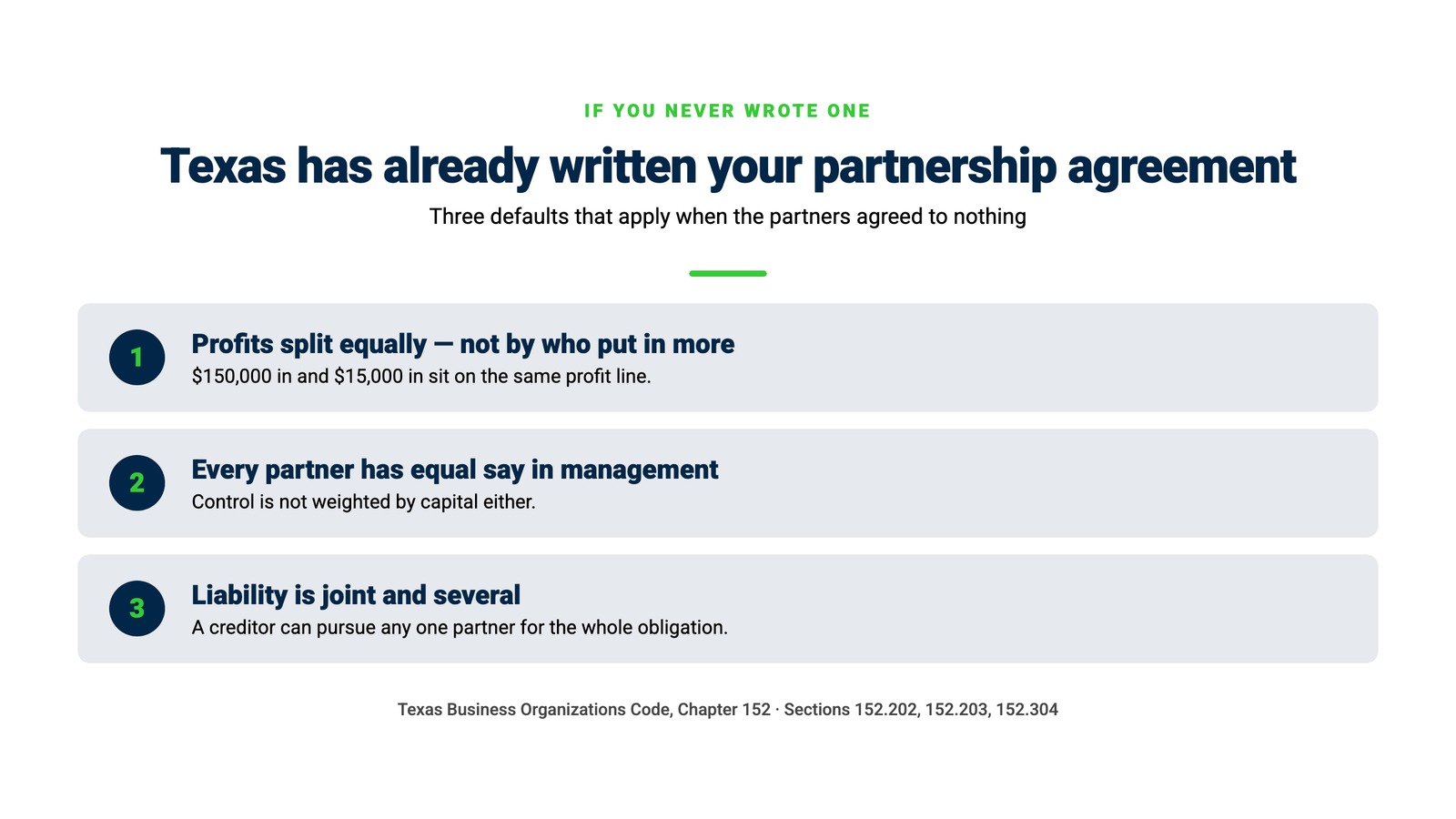
If a Texas general partnership exists and the partners never wrote anything down, Chapter 152 fills the gaps. Three of those gap-fillers catch people off guard.
Profits split equally, not by who put in more. Section 152.202 says each partner is entitled to be credited with an equal share of the partnership's profits, and is charged with losses in proportion to their share of those profits. So the person who brought $150,000 and the person who brought $15,000 sit on the same profit line. Their contributions don't vanish — the same section credits each partner with the value of what they put in — but the profit splits down the middle regardless of who funded what. That's fixable in a written agreement, and much harder to fix afterward, when it requires everyone to agree.
Control is equal too. Section 152.203 gives each partner equal rights in the management and conduct of the business, and that isn't weighted by capital either. The quiet money partner has, on paper, the same say as the person doing the work every day.
You are exposed to what your partner does. Section 152.304 provides that all partners are jointly and severally liable for all obligations of the partnership. "Jointly and severally" means a creditor can pursue any one partner for the whole obligation rather than that partner's slice of it. Your exposure isn't capped at what you put in.
That default has carve-outs worth knowing. A partner who joins an existing partnership isn't personally liable under that subsection for obligations that predate their admission, and a registered limited liability partnership is treated differently. Both are entity-structure questions to put to a lawyer.
The enforcement rules add a partial cushion. Section 152.306 says a judgment against the partnership isn't by itself a judgment against a partner, and generally a creditor needs a judgment against the partner too, plus a 90-day wait, before reaching that partner's own property. The section carries real exceptions, though — bankruptcy, a court order, a partner who agreed otherwise, or liability attaching to the partner independently. Treat it as a speed bump, not the protection a limited-liability entity provides.
None of this makes partnering a bad idea. We've been on both sides of joint deals for years, and the right partner is worth more than the right property. The problem is going in undocumented.
What writing it down can and can't change
Section 152.002 gives you the lever: a partnership agreement governs the relations of the partners, and the statute fills in only where the agreement is silent. Write it, and you overwrite the defaults between the partners — the profit split, the management split, the exit terms.
What an agreement cannot do is rearrange what an outside creditor can come after. The same section bars a partnership agreement from restricting the rights of a third party, and a creditor is a third party. Personal liability is an entity question, not a drafting question, and it's one of the better reasons to have a real conversation with a Texas attorney before the money moves rather than after.
The section sets other floors, and they're sensible. An agreement can't eliminate the duty of loyalty, the duty of care, or the obligation of good faith, and can't unreasonably restrict a partner's access to the books. Partners can define categories of conduct that don't violate the duty of loyalty, so long as those definitions aren't manifestly unreasonable — but the floor itself stays.
One more thing worth knowing before you sign. Under Section 152.208, a partnership agreement can be amended only with the consent of all partners, and under Section 152.201 a new person becomes a partner only with everyone's consent. Whatever you agree to on day one is what you live with unless every person later agrees to change it. That's a good argument for taking day one seriously.
Five things to settle before any money moves
This is the conversation we'd want to have before wiring anything, whether the other person is a stranger from a meetup or a brother-in-law.
1. Who decides what, and what breaks a tie. Who signs contracts, who picks the contractor, what dollar amount needs both signatures, and how a real deadlock resolves. Two people with equal say and no tiebreaker is a design flaw.
2. What each person is actually bringing, in writing. Money is easy to count. Time, expertise, the license, the relationship that found the deal, the credit used to qualify — those count too, and they're what people remember differently a year later.
3. How profit splits, and how losses split. Say both. People negotiate the upside enthusiastically and skip the downside entirely, and the downside is what ends friendships.
4. Who pays when it runs over. Because it will. Decide now whether an overage is a capital call split by percentage, a loan to the partnership at a stated rate, or a dilution of whoever can't fund it.
5. How somebody gets out. Covered below, and it's the one people skip hardest.
Getting out is its own conversation
Under Section 152.501, a partner stops being a partner when an event of withdrawal occurs — and one of those events is simply the partnership receiving notice of that partner's express will to withdraw. A partner can announce they're done.
Section 152.503 then separates an ordinary withdrawal from a wrongful one, which carries liability the ordinary kind doesn't. One way a withdrawal becomes wrongful is breaching an express provision of the partnership agreement. But there's a second route that needs no paperwork at all: where the partnership was formed for a particular undertaking, a partner who withdraws by express will before that undertaking is finished may be withdrawing wrongfully.
Hold that against a two-person deal to rehab and sell one house — close to the textbook definition of a particular undertaking. The partner who walks mid-flip isn't necessarily safe just because nothing was signed, which is the opposite of what most people assume.
Either way, decide in advance what happens when someone wants out. Right of first refusal on the interest? A valuation formula, or an appraisal? Can the remaining partner force a sale? Exit terms are the ones most likely to matter to whoever's left holding the project, and the time to write them is while everyone still likes each other.
The relationship is the asset
Here's the part that isn't in any statute. The reason to write this down isn't that you expect your partner to cheat you. It's that you expect to still be talking to them in five years.
Partnerships rarely go sideways because somebody turned out to be a villain. Far more often it's two decent people who remembered the deal a little differently, under stress, with money on the table. A written agreement gives them a way to disagree about a project without it becoming a disagreement about each other's character.
Between us that's more than 450 transactions and better than three decades in this business, and the thing we'd tell anybody is this: a good property with a fuzzy understanding is more dangerous than an average property with a clear one.

What we'd offer you
If you're about to go in on something with somebody, take the five questions above and answer them out loud, together, before any money moves. That costs you one uncomfortable hour. Skipping it can cost you a friendship and a year.
Then take those answers to a Texas attorney and have them papered properly. We're not lawyers, and this article isn't here to help you draft your own agreement — it's here so you walk into that office already knowing what you want it to say. That part nobody can do for you.
If you don't have anyone to think out loud with about a partnership you're weighing, that's fixable too. Most of what we know about structuring deals with other people, we learned in rooms with people who'd already made the mistakes.
If we haven't met yet, we'd like to. Tell us what you're working on and who you're thinking about building it with, and if it's useful, we're happy to share who's in our network.
Disclaimer: This content is provided for educational, informational, and entertainment purposes only. It is not legal, tax, accounting, investment, financial, or professional advice. Michelle and Vin are not acting as your attorney, CPA, financial advisor, or other licensed professional. Every situation is different. Conduct your own due diligence and consult your qualified professional team before making any business, real-estate, lending, investment, legal, tax, or financial decision. Nothing in this article is a promise or guarantee of results.